
SNGPL Bill Calculation 2026 – How to Calculate Your Gas Charges
Understanding your monthly gas bill can help you manage household expenses and identify unexpected charges. Many consumers receive an SNGPL bill without knowing how the company calculates gas consumption, MMBTU, tariff rates, and taxes.
This guide explains SNGPL Bill Calculation step by step. You will learn how to calculate gas units from meter readings, understand HM3 and MMBTU, check applicable tariff slabs, and estimate your monthly gas charges.
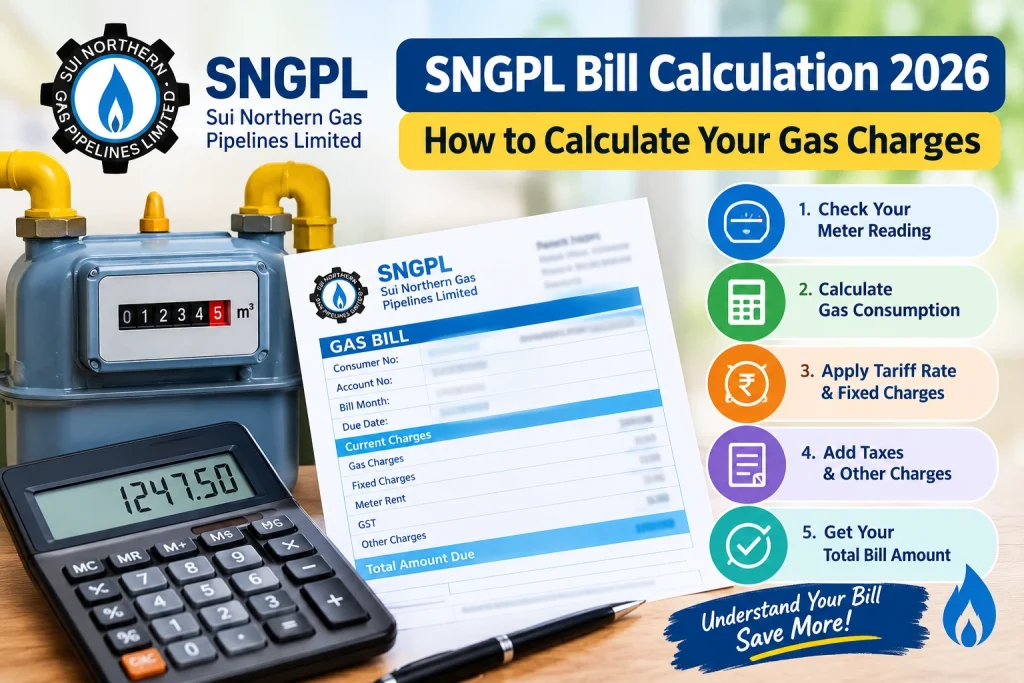
What Is SNGPL Bill Calculation?
SNGPL Bill Calculation is the process of determining your monthly natural gas charges using your meter readings, gas consumption, Gross Calorific Value (GCV), applicable tariff, fixed charges, meter rent, and taxes.
Your gas meter measures the volume of gas consumed, but billing is based on energy consumption in MMBTU. Therefore, SNGPL converts your recorded gas units into MMBTU before applying the relevant tariff.
How to Calculate SNGPL Gas Consumption
The first step is to check your previous and current meter readings.
Use this simple formula:
Monthly Gas Consumption = Current Meter Reading − Previous Meter Reading
For example:
- Previous Reading: 5,419
- Current Reading: 5,532
- Difference: 113 cubic metres
Your monthly consumption is 113 cubic metres. To convert this into HM3, divide the result by 100.
113 ÷ 100 = 1.13 HM3
One HM3 represents 100 cubic metres of gas.
How to Calculate MMBTU on an SNGPL Bill
MMBTU means Million British Thermal Units. It measures the energy contained in the gas you consume.
SNGPL uses the GCV printed on your bill to convert gas consumption into MMBTU.
The formula shown in SNGPL’s billing example is:
MMBTU = (HM3 × GCV) ÷ 281.7385
For example:
- Gas Consumption: 1.13 HM3
- GCV: 933
Calculation:
(1.13 × 933) ÷ 281.7385 = approximately 3.74 MMBTU.
Your actual GCV may change, so always use the value printed on your own bill rather than relying on an estimated figure.
SNGPL Gas Tariff Slabs 2026
SNGPL domestic consumers are generally classified into protected and non-protected categories. The applicable rate depends on the consumer category and monthly consumption.
Protected consumers receive lower tariff rates, while non-protected consumers may pay higher rates as their consumption increases.
Your bill or the latest official tariff notification should be checked to confirm the applicable rates. Do not use an old rate table for a current bill because tariffs and government charges can change.
The applicable tariff is multiplied by your calculated MMBTU to determine gas charges. Domestic billing may also include a preceding-slab benefit, depending on the applicable rules.
How to Calculate Total SNGPL Gas Bill
After calculating MMBTU, you can estimate your gas charges by following these steps:
- Calculate monthly gas consumption from meter readings.
- Convert cubic metres into HM3.
- Convert HM3 into MMBTU using the GCV on your bill.
- Apply the relevant tariff rate or slab calculation.
- Add applicable fixed charges and meter rent.
- Add GST and any other applicable charges or adjustments.
Estimated Bill = Gas Charges + Fixed Charges + Meter Rent + Applicable Taxes + Other Adjustments
For example, if your calculated gas charges are Rs. 1,000, fixed charges are Rs. 600, and meter rent is Rs. 40, the subtotal before applicable taxes is Rs. 1,640.
Your final payable amount may also include arrears, late payment surcharge, or other adjustments.
What Are Fixed Charges and Meter Rent?
Your SNGPL bill may include charges even when your gas consumption is low.
Fixed Charges: These are charges applied according to your consumer category and applicable tariff rules.
Meter Rent: This is a charge associated with the gas meter. The amount applicable to your connection is shown on your bill.
These charges are separate from the amount calculated for gas consumption.
Why Is Your SNGPL Bill Higher Than Expected?
Several factors can increase your monthly gas bill:
- Higher gas consumption: Using a geyser, heater, or stove for longer periods increases consumption.
- Tariff slab changes: Moving into a higher consumption slab can increase gas charges.
- Consumer category: Protected and non-protected consumers have different tariff structures.
- GCV changes: The energy value used in the MMBTU calculation can vary.
- Fixed charges and taxes: These are added to the gas consumption charges.
- Previous balance: Unpaid amounts and late payment surcharges can increase the payable total.
- Meter reading errors: An incorrect or estimated reading may affect your bill.
Check your current and previous readings, consumption, GCV, and billing adjustments if the amount seems unusually high.
How to Check Your SNGPL Bill Online
You can check your latest gas bill through the official SNGPL website.
Follow these steps:
- Visit the official SNGPL website.
- Open the online bill or customer services section.
- Enter the required consumer information.
- View your available billing details.
- Download or print your bill if the service provides that option.
Official website: https://www.sngpl.com.pk/
You can also use the information printed on your bill to compare your meter readings and charges.
Frequently Asked Questions
How is an SNGPL bill calculated?
SNGPL calculates gas consumption from meter readings, converts the consumed volume into MMBTU using GCV, applies the relevant tariff, and adds fixed charges, meter rent, taxes, and adjustments.
What does HM3 mean on an SNGPL bill?
HM3 represents 100 cubic metres of gas. For example, 150 cubic metres equals 1.50 HM3.
What is GCV on a gas bill?
GCV stands for Gross Calorific Value. It indicates the energy content of gas and is used to calculate MMBTU.
Why does my SNGPL bill change every month?
Your bill can change because of gas consumption, tariff slabs, GCV, fixed charges, taxes, meter readings, and previous balances.
Can I calculate my SNGPL bill manually?
Yes. You can estimate your bill using meter readings, HM3, GCV, MMBTU, and the applicable tariff. However, the final amount may differ because of taxes, adjustments, and billing rules.
Conclusion
Understanding SNGPL Bill Calculation makes it easier to check your monthly gas expenses and identify unusual charges. Start by comparing your current and previous meter readings, calculate HM3, and use the GCV printed on your bill to understand MMBTU.
Finally, check your consumer category, applicable tariff, fixed charges, meter rent, and taxes before estimating the total amount. Always compare your calculation with your official SNGPL bill for the most accurate payable figure.